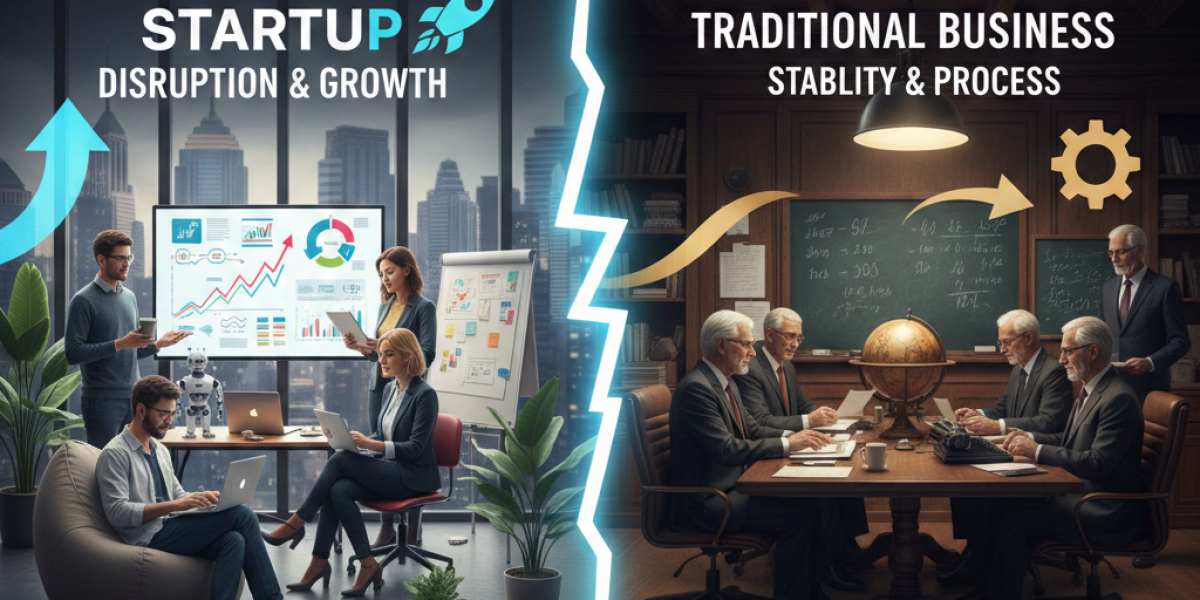
The entrepreneurial landscape presents two distinct paths for business creation: startups and traditional businesses. While both aim for success, they operate under vastly different principles, structures, and expectations. Understanding these differences is crucial for aspiring entrepreneurs, investors, and business professionals seeking to make informed decisions about which model aligns with their goals and circumstances.
What Defines a Startup?
A startup is fundamentally a newly created enterprise designed to develop an innovative product, service, or business model with the potential for rapid scaling and exponential growth. Unlike conventional businesses that follow established frameworks, startups operate in high-risk environments where the business model itself is often unproven. They focus on disrupting existing markets or creating entirely new ones through technology-driven solutions and novel approaches.
The core characteristics of startups include a commitment to innovation, a willingness to operate under uncertainty, and a strategic pivot toward market expansion over immediate profitability. Startups typically aim for annual growth rates between 50 and 200 percent in their early stages, particularly in technology-driven sectors. Examples like Zomato, Paytm, and BYJU'S demonstrate how startups identify market gaps and rapidly scale solutions that transform industries.
Understanding Traditional Businesses
In contrast, traditional businesses follow time-tested operational models within established markets. These businesses—such as local grocery stores, family-run textile operations, and restaurant chains—prioritize consistent revenue generation and predictable expansion. They operate within well-defined frameworks where customer demand is proven, competitive dynamics are understood, and operational costs are predictable.
Traditional businesses emphasize stability, profitability, and sustainable growth. They typically maintain annual growth rates of 15 to 25 percent and focus on building enduring enterprises that generate steady cash flow. Rather than seeking disruption, traditional businesses often specialize in refinement, improving existing products or services within familiar markets.
Key Differences: A Comprehensive Comparison
Growth Trajectory and Speed
The most obvious distinction lies in how these entities approach growth. Startups are engineered for rapid scaling, designed to achieve market dominance quickly and capture significant market share within a short timeframe. They willingly operate at a loss for 4 to 7 years if necessary to establish market leadership and attract investor interest.
Traditional businesses, conversely, prioritize sustainable, incremental growth. They establish profitability within 18 to 36 months and maintain conservative growth strategies that preserve capital reserves and operational stability. This methodical approach reduces the pressure to scale aggressively but also limits the potential for exponential returns.
Funding Mechanisms
The funding landscape dramatically differs between these two models. Startup Registration typically rely on external capital from venture capitalists, angel investors, crowdfunding platforms, and accelerators. Angel investors typically provide $10,000 to $250,000 per deal in early stages, while venture capital firms invest substantially larger amounts with structured frameworks and rigorous due diligence. This external funding enables rapid hiring, product development, and market expansion.
Traditional businesses, however, are often self-funded or financed through bank loans based on collateral and business history. They depend on personal savings, retained earnings, and conventional lending institutions that evaluate creditworthiness and established track records. While bank loans offer lower interest rates than venture capital, they require substantial documentation and proven business viability.
Risk and Failure Rates
Risk profiles diverge significantly between startup and traditional business models. Startups operate in high-uncertainty environments where around 70 percent fail within five years, primarily due to lack of market demand or insufficient capital. They are sensitive to investor sentiment, market fluctuations, and funding cycles. The failure rate reflects the inherent challenge of validating new business concepts and achieving market-product fit.
Traditional businesses face substantially lower risk, with approximately 50 percent surviving beyond five years. Their established market positions, proven customer bases, and predictable operational models reduce uncertainty. However, they remain vulnerable to poor cash flow management, which accounts for over 80 percent of traditional business failures.
Organizational Structure and Culture
Startups typically employ flat, flexible organizational structures that promote rapid decision-making and cross-functional collaboration. Employees often wear multiple hats, contributing across various departments and functions. This structure enables quick pivoting and reduces bureaucratic delays. The startup culture emphasizes innovation, risk-taking, and creative problem-solving, attracting individuals energized by ambiguity and change.
Traditional businesses operate under hierarchical, layered organizational frameworks with clearly defined reporting lines, established protocols, and specialized departments. This structure provides clarity regarding accountability and decision-making authority, but can create communication barriers between departments and slow adaptive responses to market changes. The culture typically emphasizes process adherence, consistency, and expertise specialization.
Product Development and Market Entry
Startups employ the lean startup methodology, emphasizing rapid prototyping, market testing, and iterative refinement based on real-world customer feedback. They develop minimum viable products (MVPs) quickly, launch them to market, and iterate based on user data. This approach minimizes initial spending while maximizing learning. Companies like Airbnb, Dropbox, and Zappos exemplify how lean principles enable rapid validation and scaling.
Traditional businesses follow comprehensive, structured planning processes. Before market entry, they conduct extensive market research, develop fully fleshed business plans, and create detailed financial projections. While this approach reduces market entry risk through thorough preparation, it also requires substantial upfront investment and time before generating revenue.
Profitability and Financial Focus
The financial priorities of these models differ substantially. Startups prioritize growth and market capture over immediate profitability. Early-stage startups often operate with monthly burn rates of ₹30 to ₹80 lakhs while seeking to achieve rapid revenue expansion. Profitability, while eventually necessary, takes a backseat to scaling metrics like customer acquisition and market penetration.
Traditional businesses focus on consistent, early profitability. They measure success through steady revenue generation and sustainable cash flow. Profit margins are closely monitored, and financial decisions prioritize operational efficiency and cost management.
Decision-Making and Adaptability
Decision-making processes in startups are agile, featuring shorter feedback loops that enable rapid experimentation and iteration. Founders make quick pivots based on market response, customer data, and emerging opportunities. This flexibility allows startups to adapt quickly when assumptions prove incorrect.
Traditional businesses follow more structured, hierarchical decision-making processes. Decisions often require approval from multiple management layers and extensive analysis. While this protects against hasty mistakes, it can slow response times to market changes.
Technology and Innovation Integration
Startups typically embed technology and digital tools as core business drivers. They leverage cutting-edge technologies to create competitive advantages and enable scalability. Technology adoption is central to their value proposition.
Traditional businesses may incorporate technology, but don't necessarily rely on it as a primary differentiator. Many traditional businesses operate successfully with established, proven systems rather than bleeding-edge technologies.
Choosing Between the Two Models
The decision between launching a startup or a traditional business depends on multiple personal and contextual factors. Individuals with high risk tolerance, significant time availability, and comfort with uncertainty may thrive as startup founders. Startups suit those seeking rapid growth, industry disruption, and the potential for significant financial returns through exits like IPOs or acquisitions.
Conversely, entrepreneurs prioritizing stability, predictable income, and sustainable growth often find traditional business models more suitable. Those with limited access to venture capital, established market knowledge in specific sectors, or a preference for operational control may succeed better with traditional approaches.
The choice also depends on industry dynamics. Technology and digital-first sectors often favour startup approaches, while service industries, retail, and manufacturing frequently align with traditional business models. Additionally, an entrepreneur's available resources, whether personal capital, networks, or expertise, should align with the chosen model.
The Modern Convergence
Interestingly, the line between these models increasingly blurs. Large traditional companies now adopt lean startup principles to foster innovation and adapt to market disruption. Simultaneously, maturing startups adopt traditional business practices regarding governance, planning, and operational rigour. As businesses grow beyond the startup phase into the scaleup stage (indicated by consistent 20 percent annual growth for three years), they increasingly incorporate traditional business structures while maintaining startup-like agility.
Conclusion
Startups and traditional businesses represent fundamentally different approaches to entrepreneurship, each with distinct advantages and challenges. Startups offer the potential for rapid growth, industry transformation, and significant financial returns, but require substantial risk tolerance and adaptability. Traditional businesses provide stability, predictable profitability, and clearer paths to success through established frameworks, though they sacrifice explosive growth potential.
The optimal choice depends on your vision, resources, risk appetite, and market opportunity. Successful entrepreneurs understand these models' nuances and select the approach that best aligns with their circumstances and objectives. In today's dynamic business environment, the most innovative approaches may involve blending startup agility with traditional business stability, creating hybrid models that capture the benefits of both philosophies.